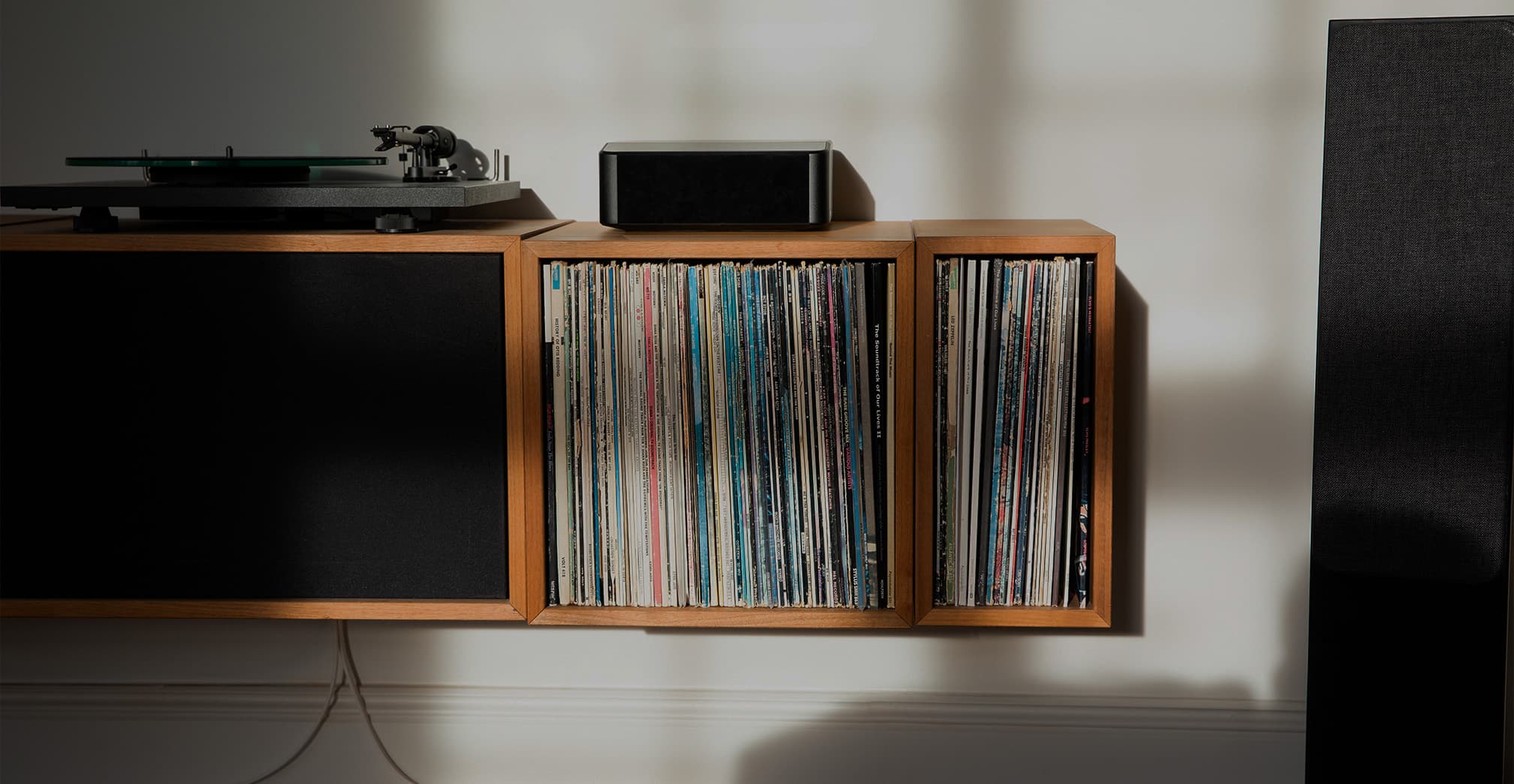
The deciding factors behind every listening experience
When people think about improving audio, they often focus on equipment first. Better speakers. A more powerful amplifier. A premium receiver. These choices matter, but they are only part of the story. What you actually hear is shaped by three connected elements: the content you play, the system reproducing it, and the room it fills.
We call these the Three S’s of audio: Source, System, and Space.
Together, they define the listening experience. And once you understand how they interact, it becomes much easier to understand why some setups sound natural, balanced, and alive, while others fall short.
Source
Everything begins with the content
The source is the audio you choose to play. That could be music, movies, podcasts, or any other form of recorded sound.
Every listening experience starts here. The quality of the original recording, mix, and master is baked in. No playback system, however capable, can add detail that was never there.
A strong source gives your system something meaningful to work with. It preserves nuance, maintains balance, and makes it easier to hear the intent behind the recording. Whether it's a carefully mastered album or a richly produced film score, the source sets the ceiling for everything that follows.
System
The playback chain that brings sound to life
The system is the hardware that reproduces the source. That might be speakers, subwoofers, amplifiers, receivers, streamers, headphones, or any other gear capable of reproducing sound.
This is where most people invest their attention, and there are real performance gains to be had here. Having the right gear matters, but equally so, how it works together. Speaker placement, integration, calibration, and tuning all influence the final result.
A well-configured system reproduces sound with control, accuracy, and consistency. Even so, no system operates in a vacuum. Even so, no system operates in a vacuum. Once sound leaves the speakers, another factor takes over.
Space
The room is always part of the experience
This is arguably the most important parts of audio playback, yet the most frequently overlooked. Sound does not travel in a straight line from the speaker to your ears. It interacts with the room,bouncing off walls, ceilings, floors, windows, and furniture.
Those reflections change what you hear. Certain frequencies get amplified; others get swallowed. Detail blurs. Bass becomes uneven. Clarity suffers.
Even with a system built from high quality components, the room can change the result dramatically. That is why a sound system that's impressing in the showroom can feel disapointing in your living room.
In practical terms, the space is not just where you listen. It is part of the system.
Why the Three S’s matter
The value of the Three S’s framework is that it gives a clearer way to think about sound quality.
If the source is compromised, detail is lost before playback begins. If the system isn't properly configured, that detail doesn't survive the chain. If the room interferes, what reaches you has already been altered.
That is why improving your sound is rarely about changing just one thing. It is about understanding the full chain and identifying where the real limitations are.
Helping your system perform accurately in your room
At Dirac, we focus on the part of the chain that matters most and gets addressed least: the space
By measuring the listening space and correcting the signal, Dirac Live makes your system sound like it’s in a perfect room. First, the software automatically adjusts timing and phase, so the sound from each speaker reaches your ears at the right moment, creating a clearer and more natural sound. It also allows you to fine tune the frequency balance, so you can shape the sound to match your preferred sound profile.
The goal is not to change the sound. It is to help you hear more of it, with greater clarity, balance, and control.
Better sound starts with a better understanding
The Three S’s of Audio Playback offer a simple way to understand a complex reality.
Source is what you play.
System is what plays it.
Space is what shapes how you hear it.
When all three work in harmony, the result is a more natural, more immersive, and more accurate listening experience.
And when it comes to achieving better sound, the room may be the most powerful factor of all.